


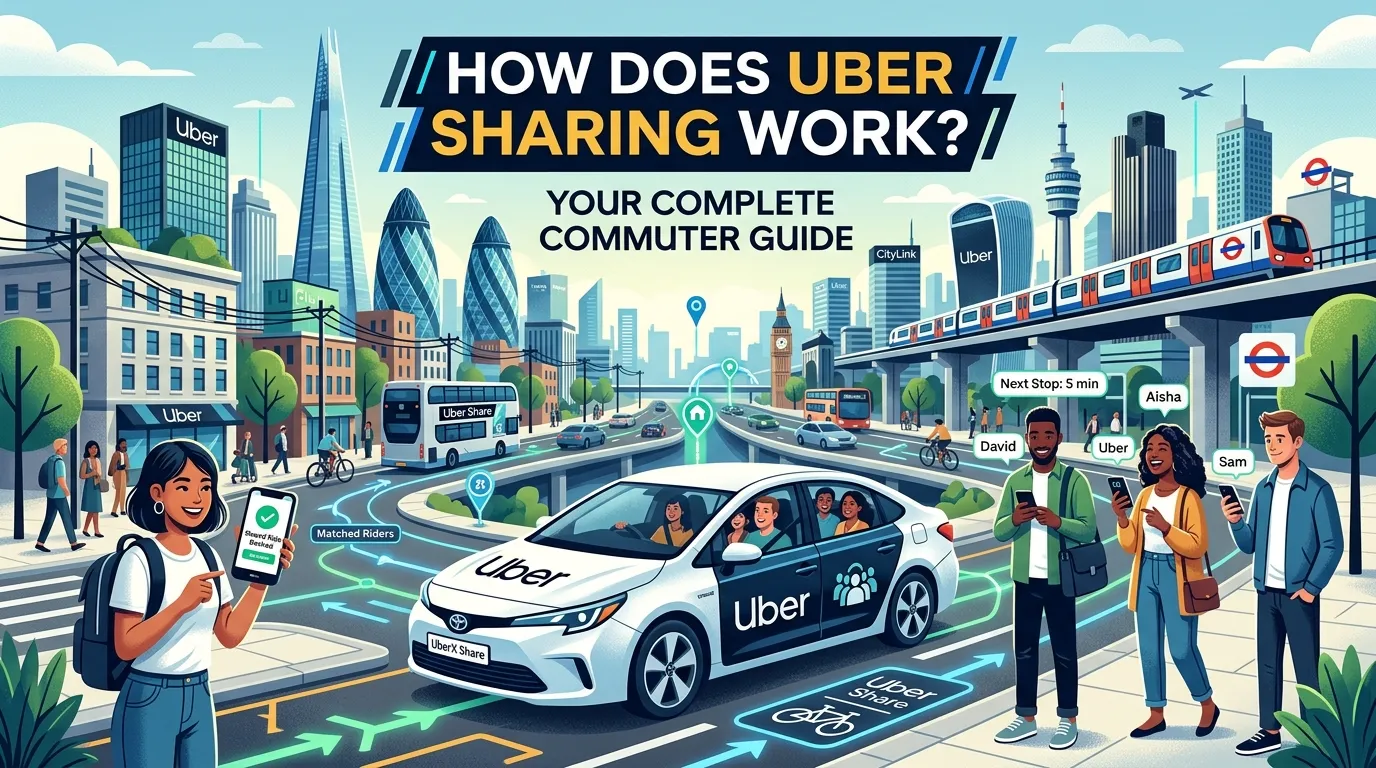
Uber Sharing pools riders traveling in similar directions, reducing costs, congestion, and emissions. AI matching assigns co-riders, dynamically adjusts routes, and ensures safety. Users enjoy affordable, efficient transport with slight trade-offs in time and privacy.
Commuting often feels like a daily puzzle of conflicting schedules, tight budgets, and frustrating traffic jams. As urban populations continue to grow, the demand for smarter, more adaptable transportation solutions has never been higher. Uber Sharing steps in as a highly practical alternative to private rides and crowded public transit. By allowing multiple riders heading in the same general direction to share a single vehicle, this service completely reshapes how we navigate our cities.
For budget-conscious commuters and environmentally aware travelers, understanding exactly how does uber sharing work opens the door to a more efficient transit experience. This service fundamentally changes the standard logistics of a rideshare by pooling resources and routes. You get the distinct convenience of a car ride without bearing the full financial cost alone.
If you are curious about the mechanics behind this popular service, you are in the right place. We will explore the step-by-step process of requesting a shared ride and the complex technology that powers it. We’ll look at advanced tips, user scenarios, and the impact of ride sharing on transportation. Let us dive into the distinct advantages this service brings to your daily commute.
The Core Mechanics: How Does Uber Sharing Work?

The concept of sharing a ride is incredibly simple on the surface. However, the technology running constantly behind the scenes is highly sophisticated. Here is exactly what happens when you decide to share your journey with others.
Requesting Your Shared Ride
When you open your Uber app and enter your final destination, you will see a list of vehicle options. Selecting the “Share” option indicates you are willing to ride with other passengers. The app immediately displays an upfront price for your trip.
This quoted price is typically much lower than a standard private ride. Once you confirm the request, the platform begins searching for an available driver. At this exact moment, the system also starts looking for other riders traveling along your route.
If you want to make your commute even more predictable, you can input your pickup location a few extra minutes early so you don’t have to rush out the door when your driver is approaching. It’s a small action, but it gives both you and your co-riders a better, more reliable experience.
The Technology Behind the Scenes
As soon as your request goes through, complex matching systems spring into action. This software analyzes thousands of active requests in real time. It looks for other passengers who are traveling along a similar route and matches you with a driver who can accommodate everyone.
The system accounts for current traffic conditions, estimated pickup times, and vehicle capacity. This ensures the pairing makes logistical sense for everyone involved. Uber’s technology leverages artificial intelligence and route optimization algorithms to get the most efficient use out of every shared trip — explore more about understanding algorithms and AI at Uber if you want a deeper dive into how the magic happens.
Dynamic Route Adjustments in Real-Time
A shared ride rarely follows a perfectly straight line. Because the driver is picking up and dropping off multiple passengers, the route updates dynamically. If a new passenger requests a ride that aligns with your current path, the app adds them to the trip.
The software recalculates the GPS directions instantly to include the new stop. This means your drop-off time might shift slightly during the journey. However, the system is designed to prevent excessive detours, keeping your overall travel time reasonable.
If you’re wondering, “how does Uber matching algorithm work?”—it’s all about balancing rider convenience, driver earnings, and traffic conditions in real time. The algorithm can even rearrange the pickup sequence on-the-fly if a new match is more efficient.
Safety and Security in Uber Sharing
Safety is a top priority, and Uber employs several features—such as real-time ride tracking, trip status sharing, and a built-in emergency button—so everyone can feel secure, even when sharing space with unfamiliar faces. Every rider must agree to and follow Uber’s community guidelines, and you can always leave feedback after a trip.
Understanding Fares, Pricing, and Payments
One of the most appealing aspects of a shared ride is the highly attractive pricing structure. You lock in a discounted rate the moment you request the ride. Even if the driver does not find another passenger to share the car with you, you still pay the lower quoted fare.
Payments are handled seamlessly through the app, exactly like a standard Uber trip. You do not need to worry about splitting the bill physically with your co-riders. The app calculates everything independently based on your specific pickup and drop-off points.
If you want to know how does uber sharing work regarding surge pricing, it applies here too. However, the shared option usually remains the most economical choice even during busy hours.
Factors That Influence Shared Ride Pricing
- Distance and Route Complexity: A longer trip or an out-of-the-way destination may result in a higher share fare, but it typically still beats booking a private ride.
- Time of Day and Demand: During peak hours or city events, increased demand may lead to slightly higher shares (though still below solo trip prices).
- Current Rider Supply: If there are lots of people requesting shared rides along your route, you’ll get the maximum savings.
Keep in mind that while you “share” a car, you never have to physically split the fare with strangers—the Uber app automatically calculates each passenger’s portion.
Types of Uber Sharing Services Available
Uber has adapted its sharing model extensively over the years. These changes meet the evolving needs of riders and city regulations.
The Evolution from Uber Pool to UberX Share
Formerly known as Uber Pool, UberX Share is the current iteration of the company’s flagship sharing service. It generally allows up to two passengers per request to join a ride. This updated service limits the total number of pickups to keep the journey efficient.
By capping the number of riders, it ensures you do not spend an excessive amount of time detouring. This creates a much better balance between saving money and arriving at your destination on time.
Who Should Use UberX Share?
- Daily Commuters: Perfect for people with regular travel times and destinations.
- Budget Travelers: Great for those looking to cut transportation costs.
- Visitors and Students: Fantastic for exploring cities or getting to and from events at a lower price.
- Small Groups: Two friends heading in the same direction can ride together for even less.
Consistently choosing UberX Share helps normalize ride sharing and can lead to more widespread adoption, making your city’s traffic and emissions a little better for everyone.
Regional and Specialized Options
Depending on where you live, you might encounter other localized sharing options. Some major cities offer high-capacity shared vehicles like shuttles or vans during peak commute hours. These act almost like dynamic, on-demand bus routes.
Always check your app to see the specific sharing tiers available in your local market. The options frequently change based on local demand and city transit partnerships.
Accessibility and Inclusivity
Uber has worked to ensure their sharing services are as inclusive as possible. Some regions may offer wheelchair-accessible shared vehicles or extra-large rides for families and groups, widening the appeal and practical usability of shared taxi service Uber options.
Comparing Ride Options: A Commuter’s Breakdown
Understanding how sharing stacks up against other transit methods helps you make the best choice. This comparison table highlights the key differences.
|
Feature |
UberX (Private) |
UberX Share |
Public Transit |
|---|---|---|---|
|
Privacy |
High |
Low to Medium |
Low |
|
Cost |
Highest |
Moderate |
Lowest |
|
Route |
Direct point A to B |
Dynamic w/detours |
Fixed routes and stops |
|
Flexibility |
On-demand anywhere |
On-demand, limited zones |
Strict schedules |
|
Travel Time |
Fastest |
Moderate |
Often slowest |
When to Use Each Mode
- UberX: When time, privacy, or special needs (lots of luggage, unique destination) matter most.
- UberX Share: When cost and environmental impact are your priorities, and you’re flexible.
- Public Transit: When price is paramount and you are comfortable with fixed schedules and stops.
The Major Benefits of Sharing Your Ride

Choosing to share your ride brings several tangible benefits. These advantages extend well beyond your personal wallet and impact the broader community.
Financial Savings for Daily Commuters
The most immediate advantage is the obvious financial savings. Shared rides are consistently cheaper than private ones. If you rely heavily on ridesharing for your daily commute, these savings compound significantly.
Over the course of a month, choosing the shared option can save you hundreds of dollars. It is the perfect middle ground for those who want the comfort of a car without the premium price tag.
Smart commuters often reserve their private UberX only for special occasions—using UberX Share or pooled rides the majority of the time to stretch their monthly budgets.
Environmental Impact and Sustainability
Transportation remains a major contributor to global greenhouse gas emissions. By sharing a vehicle, you effectively remove another car from the road. Fewer vehicles mean lower overall emissions for your city.
This makes sharing rides a more sustainable choice for environmentally conscious riders. As more people ask how Uber sharing works and adopt the service, the collective carbon footprint shrinks.
Uber itself reports that ride-sharing models have the potential to significantly reduce city congestion and emissions, especially when paired with electrification and future autonomous vehicles.
Easing Urban Traffic Congestion
City infrastructure frequently struggles under the weight of excessive traffic. When multiple people utilize a single car instead of hailing separate vehicles, overall congestion decreases. This helps traffic flow much more smoothly for everyone on the road.
Less congestion means faster travel times across the board. It also reduces the wear and tear on city roads, creating a better driving environment overall.
Community & Social Perks
While not everyone wants to chat on a rideshare, many have enjoyed striking up conversations with strangers, networking, or even making new friends—something you’d never expect from a private ride.
Potential Downsides and Considerations
While the benefits are abundantly clear, shared rides are not perfectly suited for every situation. You should carefully consider a few trade-offs before booking your next trip.
Managing Longer Travel Times
Because your driver must pick up and drop off other passengers, your total travel time increases. It will always be longer than a direct, private ride. If you are rushing to a time-sensitive appointment, a shared ride might cut it too close.
You should always build a buffer into your schedule when choosing this option. Planning ahead eliminates the stress of unexpected detours.
Example Scenario
A 15-minute solo ride at peak traffic might stretch to 25–30 minutes in UberX Share if several pickups and drop-offs are along your route. For commuting or errands, this is rarely an issue—but don’t risk it if you have a flight to catch!
Sharing Personal Space
Sharing a backseat with a total stranger means sacrificing the privacy of a solo trip. You will have to be mindful of phone conversations and your personal space. It requires a baseline level of social awareness.
If you need to conduct a confidential business call or simply want quiet time, a private ride is better. Understanding how does uber sharing work means accepting these minor social compromises.
Quiet Options and Etiquette
If you value peace, bring headphones or simply let your co-riders know you’d prefer a quiet ride. Most people are happy to oblige. Uber’s rating and feedback tools help encourage courteous, positive interactions.
Expert Tips for a Smooth Uber Sharing Experience
A little bit of preparation goes a long way. Use these tips to ensure your shared ride is pleasant for everyone involved.
- Be Ready for Pickup: Shared rides operate on a strict schedule. Drivers typically only wait a minute or two before moving on to the next passenger.
- Confirm Your Destination: Double-check your drop-off address before requesting the ride. You generally cannot change your destination once the trip begins.
- Be Courteous: Simple manners make a huge difference. Greet your driver, keep your voice down, and avoid bringing strong-smelling food into the car.
- Pack Light: Since you are sharing trunk and seat space, avoid traveling with massive amounts of luggage.
- Use the App’s Tools: Utilize real-time driver tracking, ETA estimates, and messaging so everyone is always in sync.
Pro Tip
Travel at off-peak times or slightly out of rush hour to maximize your savings and reduce wait times—Uber’s ride-sharing explained feature often shows exactly when you can expect the shortest rides.
The Future of Shared Urban Mobility

The technology driving our daily commutes continues to advance at a rapid pace. Artificial intelligence will play a massive role in predicting transit demand. Future AI models might anticipate ride requests before they even happen.
This would allow platforms to position vehicles in optimal locations, reducing wait times to near zero. Furthermore, as cities push for greener initiatives, shared rides will likely integrate heavily with electric vehicles. An electric, shared fleet represents the ultimate goal for sustainable urban mobility.
Potential Innovations on the Horizon
- Autonomous Shared Cars: Imagine never having to drive again—just summon an electric ride that’s always nearby, automatically routing to pick up and drop off your co-riders.
- Unified Mobility Platforms: Apps that integrate shared ride, bike, e-scooter, and transit all in one streamlined interface.
- Data-Driven Traffic Relief: AI that analyzes city patterns in real time, rerouting ride shares and public transit dynamically to relieve bottlenecks and improve efficiency.
The Uber Pool ride system and other platforms are likely testbeds for these future concepts.
Frequently Asked Questions
How does Uber sharing work for the driver’s payout?
Drivers earn money based on the total distance and time of the entire trip, including all detours. Even if multiple passengers pay discounted rates, the driver’s earnings combine to reflect the total effort of the shared journey.
Can I bring a friend with me on a shared ride?
Usually, you can select up to two seats when requesting a shared ride. Keep in mind that requesting two seats will slightly increase your fare compared to riding entirely solo. Always specify the correct number of passengers in the app.
What happens if the driver does not find a co-rider?
If the matching algorithm fails to find another passenger along your route, you get a private ride at the discounted price. You lock in the lower fare the moment you request the trip, regardless of whether someone else joins.
Is it safe to share an Uber with strangers?
Yes, Uber maintains the same safety standards for shared rides as private ones. All riders and drivers are tracked via GPS, and you can share your trip status with trusted contacts. The app also enforces community guidelines to ensure respectful behavior.
Why did my arrival time change during the trip?
Your arrival time shifts because the system found a new passenger along your route. The app dynamically recalculates the GPS directions to accommodate the new pickup and drop-off. The system aims to keep these delays as brief as possible.
Can I change my destination during a shared ride?
No, you generally cannot change your final destination once a shared ride begins. The algorithm has already mapped out a highly specific route based on the original data. Altering the destination would unfairly disrupt the travel times of your co-riders.
How much luggage can I bring on a shared ride?
You should travel light when booking a shared ride. Because you are sharing the vehicle’s trunk and cabin space, large suitcases might not fit. If you have significant luggage, booking a private UberX or UberXL is highly recommended.
How does Uber sharing work if I am running late?
Drivers on shared trips operate on tight schedules and will only wait one to two minutes at your pickup spot. If you are late, the driver will cancel the ride to avoid delaying the other passengers. Always be at the curb ready to go before the car arrives.
Are there alternatives to Uber for shared commuting?
Yes, many cities offer specialized shuttles, carpooling apps, or localized van services. If you are exploring all your local commuting options, looking into finding the best private transportation services near me can help you discover alternatives suited to your neighborhood.
Do I have to talk to the other passengers?
No, conversation is entirely optional. While some people enjoy networking or chatting during their commute, it is perfectly acceptable to put on headphones and enjoy a quiet ride. Just be polite and respect the personal boundaries of everyone in the car.
Navigating the Future of Commuting
Uber sharing transforms a standard car ride into a highly optimized, community-driven transit solution. By leveraging advanced matching algorithms and dynamic routing, the platform offers a compelling mix of affordability and environmental responsibility.
While it requires a bit of flexibility regarding travel time and privacy, the trade-off is often well worth the financial savings. As you plan your next trip across town, consider whether pooling your ride makes sense for your schedule. By choosing to share, you keep extra money in your pocket while actively participating in a more sustainable future for urban transportation.
