


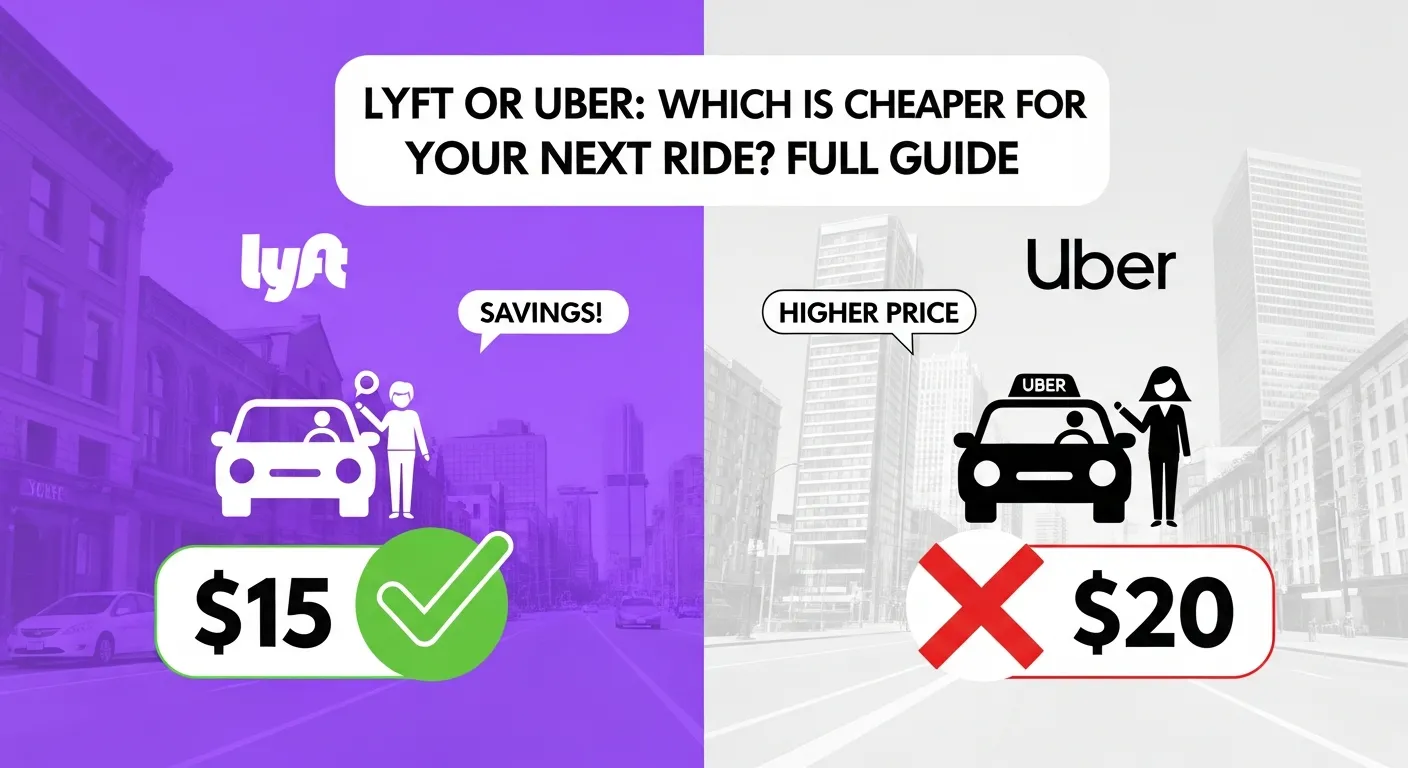
Lyft and Uber have similar base pricing, but real costs depend on demand, time, and location. Comparing both apps in real time, avoiding surge periods, and using promotions helps you consistently find the cheapest ride.
You are standing on a busy sidewalk, watching the battery on your phone slowly drain. You need to get across town, and the perpetual dilemma sets in. Do you open the pink app or the black app? Most riders simply want to know the answer to one highly specific question: Lyft or Uber is cheaper?
Both Uber and Lyft have completely transformed urban transportation over the last decade. They replaced traditional taxi hailing with a few taps on a smartphone screen. Uber launched first and maintains a larger global footprint, while Lyft quickly followed as a quirky, friendly alternative that has since matured into a fierce competitor. When looking at a ride sharing cost comparison, the battle for your wallet is intense.
Despite their similar services, the total cost of your ride can vary wildly between the two platforms. Pricing algorithms shift by the minute. One app might quote a reasonable fare, while the other demands double for the exact same route.
This post will compare Lyft and Uber across various pricing factors to determine which is generally cheaper and why. We will explore how their pricing models work, examine real-world scenarios, and share actionable tips to ensure you always find the cheapest ride sharing app.
How the Companies Make Money
Both Lyft and Uber operate using technology-driven marketplaces, balancing driver incentives with rider demand. But when you break down where every dollar goes, it impacts whether Lyft or Uber is cheaper for your ride.
After every trip, a portion of your fare goes to the driver, and the rest funds platform operations, marketing, app development, insurance, and support. Both brands frequently update their fee structures, which in turn affects Uber vs Lyft pricing and your out-of-pocket cost. Occasionally, new fees appear—everything from airport surcharges to safe-ride fees—which can only be found through careful ride sharing cost comparison before confirming a ride.
Understanding Ride-Sharing Pricing Models
Before you can figure out if Lyft or Uber is cheaper on any given day, you need to understand how these companies calculate your fare. The final number you see on your screen is the sum of several different moving parts. The Uber vs Lyft pricing battle relies heavily on these core components.
Base Fare
Every ride starts with a base fare. This is a flat fee charged simply for initiating the trip. It acts as the foundation of your total cost. The base fare varies depending on your city and the type of ride you request. A standard economy ride will have a relatively low base fare, while requesting a luxury SUV will start at a significantly higher price point. When evaluating the Uber vs Lyft cost difference, base fares are usually the most stable element.
Per-Mile and Per-Minute Rates
Once you get in the car, the meter starts running. Ride-share companies charge you for both the distance traveled and the time spent in the vehicle.
- Per-mile rate: Compensates the driver for the distance covered and fuel used.
- Per-minute rate: Ensures the driver gets paid for their time, particularly if you end up stuck in bumper-to-bumper traffic.
Time in Traffic: A Closer Look
The per-minute rate especially comes into play in dense traffic environments. If you are commuting in San Francisco during rush hour, your ride’s cost can climb substantially just due to time spent waiting in traffic lights or in congestion. In detailed ride-sharing cost comparisons, time-based fees sometimes overshadow per-mile costs, making the time of booking critical to determine whether Lyft or Uber is cheaper.
Dynamic Pricing Mechanisms
Dynamic pricing is the wild card of ride-share costs. Uber calls it “Surge Pricing,” while Lyft refers to it as “Prime Time.” When demand for rides in a specific area outpaces the number of available drivers, both apps automatically increase prices.
This system encourages more drivers to get on the road and head toward busy areas. The impact on your wallet can be severe. A simple $10 trip can quickly escalate to $30 or more during a rainstorm or right after a major concert ends. Determining whether Lyft or Uber is cheaper often comes down to which app is surging less.
Additional Fees and Taxes
The final puzzle pieces of your fare include various fees and taxes. Both platforms charge a booking fee (sometimes called a service fee) to cover their operational costs, safety features, and customer support. If your route includes toll roads or bridges, those costs pass directly onto you. Local governments also frequently impose specific taxes on ride-share trips.
Lyft vs. Uber: A Direct Comparison of Pricing Components
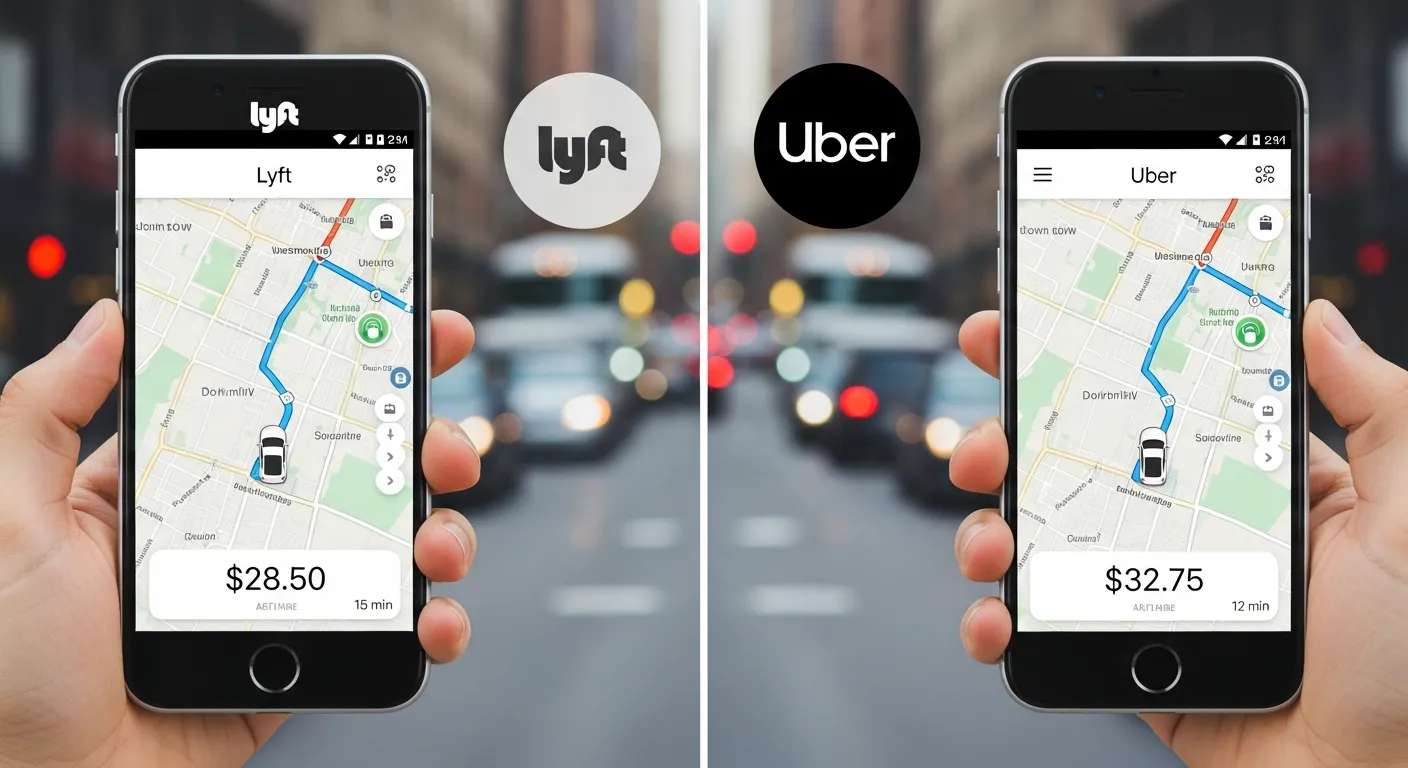
With a solid grasp on how fares are calculated, we can look at a direct comparison of the two platforms to find the cheapest ride-sharing app.
Base Fares and Time/Distance Rates
In most major American cities, the base fares for UberX and Lyft Standard are nearly identical. Both companies monitor each other closely and adjust their foundational pricing to remain competitive. A base fare in a mid-sized city might be $1.00 for Uber and $1.10 for Lyft. These small discrepancies rarely dictate which app will be significantly cheaper for a long journey.
Similarly, the per-mile and per-minute rates are highly competitive. Over a ten-mile trip, the difference in these base rates might amount to less than fifty cents. The true divergence in the Uber vs Lyft cost difference almost always comes down to dynamic pricing and timing.
To dig deeper into their operational models, you can explore the key differences between Uber and Lyft to understand how their corporate structures influence rider costs.
Surge Pricing vs. Prime Time
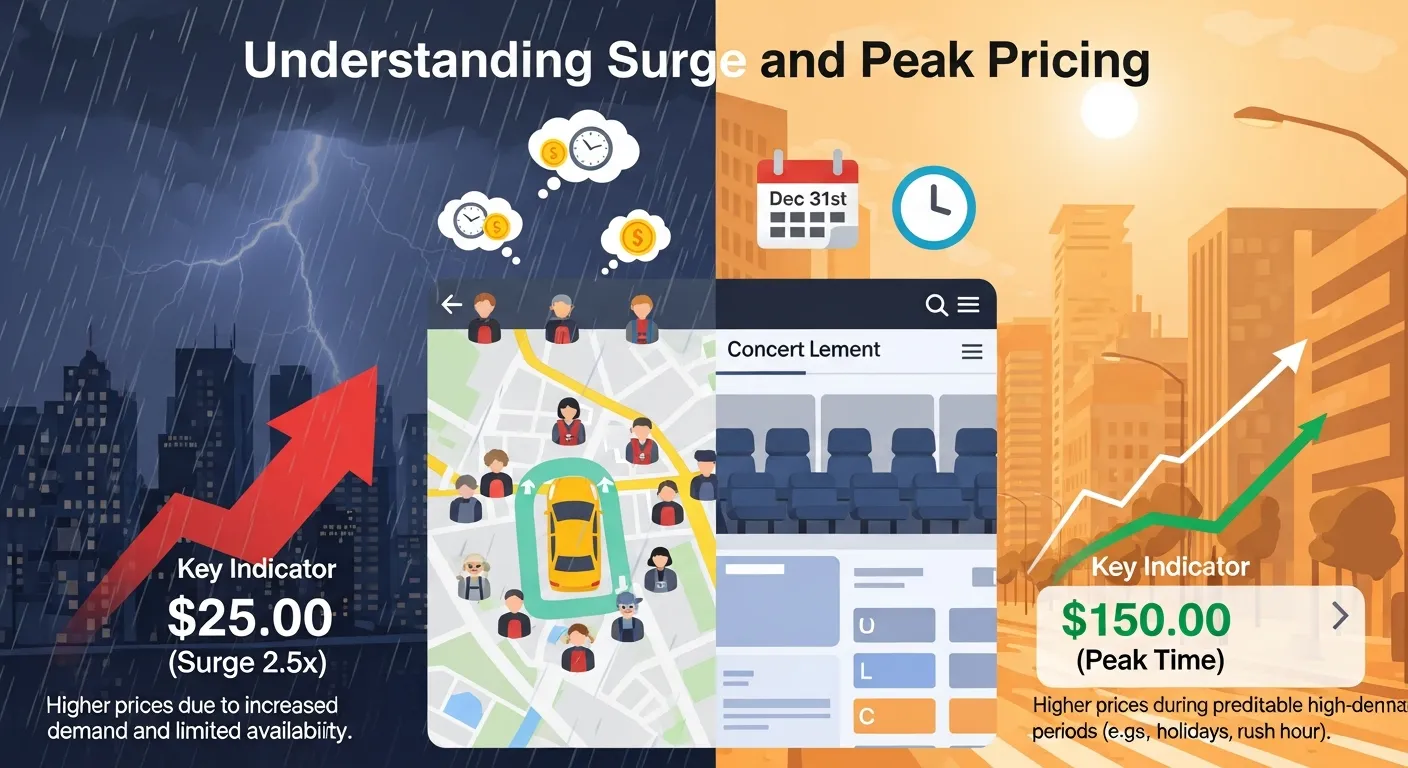
Uber’s Surge Pricing and Lyft’s Prime Time operate on the same economic principles but often trigger at different times.
|
Feature |
Uber (Surge Pricing) |
Lyft (Prime Time) |
|---|---|---|
|
Trigger |
High demand, low driver supply |
High demand, low driver supply |
|
Visibility |
Upfront total price clearly shown |
Upfront total price integrated into fare |
|
Frequency |
Often triggers faster due to larger user base |
Highly localized, varies by neighborhood |
|
Impact |
Multiplies base fare significantly |
Increases cost percentage dynamically |
Comparing the two apps during a busy hour is the only reliable way to see which algorithm is currently being more aggressive. This direct ride sharing cost comparison is essential for budget-conscious travelers.
Factors Influencing Ride-Share Costs
Pricing is never static. Several external factors constantly push and pull the cost of your ride, dictating whether Lyft or Uber is cheaper.
Time of Day and Day of the Week
Taking a ride at 2:00 PM on a Tuesday will almost always be cheaper than 2:00 AM on a Sunday. Commuting hours (7:00 AM to 9:00 AM and 4:00 PM to 6:00 PM) consistently see elevated prices due to high demand. Weekend nights are notoriously expensive.
Example Scenario: Weekday vs. Weekend
For example, let’s say you’re requesting a ride at 5:30 PM on a Friday. Both Lyft and Uber are likely to be in surge or Prime Time. For that exact same trip at 11:00 AM on Monday, you’ll often see a lower and nearly identical price for both apps. Understanding the relationship between time, demand, and pricing is essential when comparing Uber vs Lyft pricing.
Demand, Supply, and Weather
Weather events drastically alter supply and demand. A sudden downpour sends pedestrians scrambling for cars, triggering massive price surges. Major sporting events, conventions, and concerts have the same localized effect on Uber vs Lyft pricing.
Special Events: A Closer Look
Sporting games, concerts, conferences, and festivals can all send prices soaring. Live ride sharing cost comparison is essential if you’re leaving a stadium with thousands of other attendees. Set price alerts, monitor both apps, and consider waiting for demand to level off.
Specific Ride Types
Your vehicle choice heavily dictates the price. Choosing to ride in standard vehicles keeps costs low.
- Economy: UberX, Lyft Standard (Best for tight budgets)
- Shared: UberX Share, Lyft Shared (Cheapest ride sharing app option)
- Premium: Uber Black, Lyft Lux (Highest cost, premium service)
- Large Groups: UberXL, Lyft XL (Best for families or groups of 5-6)
Business and Special Requests
Premium vehicles and group rides add convenience and comfort, but they impact the Uber vs Lyft cost difference considerably. Only request a luxury ride if you truly need it—otherwise, stick with standard to increase the odds that Lyft or Uber is cheaper.
Promotions and Subscriptions
Lyft and Uber frequently offer promotions to win your loyalty. First-time riders almost always receive generous discounts. Additionally, subscription models change the math entirely:
- Uber One: Offers discounts on rides and free delivery on Uber Eats.
- Lyft Pink: Offers relaxed cancellation rules, free priority pickups, and discounted rides.
Long-Term Benefit
Committing to a subscription plan can dramatically change your regular pricing. If you’re a daily commuter, the cumulative savings means one service may always be your cheapest ride sharing app.
Case Studies: Real-World Uber vs Lyft Pricing
To truly answer if Lyft or Uber is cheaper, we must look at how they perform in common scenarios.
Commuting During Rush Hour
During a morning commute in a city like Chicago, pricing is volatile. Uber might quote $22 for a ride to the office, while Lyft quotes $28 because a large chunk of drivers are busy completing other trips. The next morning, the roles could be entirely reversed.
Typical Rush Hour Price Difference
|
City |
Uber Fare |
Lyft Fare |
Notes |
|---|---|---|---|
|
Chicago |
$22 |
$28 |
Prices flip-flop on demand |
|
Los Angeles |
$18 |
$16 |
More Lyft drivers on weekday |
|
New York |
$35 |
$37 |
Both can surge above $40 easily |
Late-Night Rides
After a busy night out, Uber’s larger fleet size sometimes works to its advantage. More drivers on the road can absorb the high demand, keeping surge pricing lower. However, Lyft is known to target the late-night crowd with specific localized promotions.
Example: Saturday Night Downtown
On a Saturday at 1:30 AM downtown, one user reported a $31 Uber and a $29 Lyft. But only Uber had available drivers under 5 minutes away, making the small price difference worth the wait. Evaluating the Uber vs Lyft cost difference sometimes comes down to your specific urgency.
Airport Travel
Airports are highly regulated for ride-shares. Both apps pay fees to the airport, which pass to you. A trip to the airport is often standard pricing, but a trip from the airport is highly subject to the number of flights landing at that exact moment. You must conduct a real-time ride sharing cost comparison right at the baggage claim.
Airport Surcharges & Tips
- Check both apps immediately after your flight lands.
- Be mindful of baggage claim rushes (can cause instant surges).
- Walk to a secondary pickup zone if possible to lower price.
Suburban and Rural Travel
In areas with fewer ride-share drivers, availability—not just price—matters most. Sometimes Lyft or Uber is cheaper simply because the other app has no nearby drivers at all.
User Experience: Beyond Just Price
While “Lyft or Uber is cheaper” is the primary question for most riders, experience factors also matter and can affect value.
App Interface & Ease of Use
Some users prefer Lyft’s design and driver-friendly tone. Others like Uber’s mapping, estimated arrival times, and familiarity. If you need to get somewhere fast, the app that lets you order and pay seamlessly can impact the real value of your ride.
Safety Features and Customer Support
Both companies now offer in-app emergency buttons, share trip status, and real-time help. When choosing the cheapest ride sharing app, ensure it also delivers peace of mind.
Driver Incentives and Quality
Uber’s larger driver pool can sometimes result in faster pickups, but individual driver quality varies everywhere. Both companies allow for ratings, but regional differences in average driver ratings can change over time.
Pros and Cons: Lyft or Uber Is Cheaper?
Let’s take a direct look at the most important advantages and disadvantages of each app in determining which is the cheapest ride sharing app for your situation.
Lyft Advantages
- Sometimes offers targeted promotional pricing in cities with heavy Uber presence.
- Friendly branding; some report a more personable driver experience.
- Good subscription benefits with Lyft Pink.
Uber Advantages
- Larger driver network, especially handy for late-night and rural rides.
- Integrated with Uber Eats and package delivery.
- Fast surge detection, so you know your fare up front.
Common Cons
- Both can raise prices significantly during surge or Prime Time, often with little warning.
- App glitches or connectivity issues can affect real-time pricing.
- Sometimes neither app is available, forcing fallback options like taxis or public transportation.
In-Depth : Features and Fee Comparison
|
Feature |
Uber |
Lyft |
|---|---|---|
|
Base Fare |
$1.00 – $2.00 |
$1.10 – $2.20 |
|
Per-Mile Rate |
$0.80 – $1.40 |
$0.75 – $1.35 |
|
Per-Minute Rate |
$0.20 – $0.35 |
$0.19 – $0.32 |
|
Cancellation Fee |
$5+ (variable by city) |
$5+ (variable by city) |
|
Airport Surcharge |
$2 – $6 |
$2 – $6 |
|
Surge/Prime Factor |
Up to 3x base during peak |
Up to 2.5x base during peak |
|
Promotions/Subs |
Uber One discounts, Eats credits |
Lyft Pink priority, ride discounts |
|
Availability |
Global, rural, suburban, urban areas |
US/Canada, urban focus |
|
User Experience |
Consistent, fast loading |
Friendly, simple navigation |
Tips for Power Users: Maximizing Your Savings
If you regularly use ride-sharing, these additional strategies can keep costs in check and help you determine every time whether Lyft or Uber is cheaper—before you book.
Monitor Both Apps Regularly
Price surges can dissipate or spike in a matter of minutes. Keep an eye on both, refresh frequently, and don’t book until you see a price you’re comfortable with.
Follow Social Media for Promo Codes
Savvy riders report significant savings by following both brands on Twitter, Instagram, and Facebook. Seasonal and local promo codes are regularly shared, providing instant discounts and contributing to the lowest ride sharing cost comparison.
Use Maps to Choose Cheapest Pick-Ups
Look for pick-up zones just outside stadiums, malls, or event hubs. A two-minute walk could easily save $10–$15 if you avoid the highest demand area.
Refer Friends or Join Rewards Programs
Both apps offer referral bonuses; share your code with friends and earn ride credits. Also, check your app’s rewards or points tabs for additional ways to save.
Frequently Asked Questions (FAQ)
Is Lyft or Uber cheaper on average?
There is no definitive winner. Base rates are virtually identical, meaning the final price depends heavily on localized surge pricing, time of day, and driver availability at the exact moment you request a ride.
How do I find the cheapest ride sharing app in my area?
The most reliable method is to keep both apps installed on your phone. Whenever you need to travel, enter your destination into both platforms simultaneously to compare the upfront pricing directly.
What is the Uber vs Lyft cost difference for airport trips?
Airport trips often include specific surcharges imposed by the airport itself. While base fares are similar, one app might have more drivers waiting in the staging lot, causing the other app to trigger surge pricing.
Do subscriptions make Lyft or Uber cheaper?
Yes. If you frequently use these services, joining Uber One or Lyft Pink provides flat percentage discounts on rides. Subscribing to one platform will generally make it the cheapest ride sharing app for your daily needs.
Why did my ride cost more than the original estimate?
If you change your destination, add an extra stop, or ask the driver to wait for an extended period, the apps will adjust your final fare based on the extra time and distance accumulated.
How can I avoid surge pricing and Prime Time fees?
You can avoid high fees by walking a few blocks away from crowded events, waiting 15 to 20 minutes for demand to die down, or scheduling your ride in advance to lock in a specific rate.
Are there other alternatives if both apps are too expensive?
If dynamic pricing is pushing fares too high, you might want to look into local taxis, public transit, or specialized local car services. You can learn how to find the best transportation services near me to explore all your regional transit options.
Does the type of vehicle affect the Uber vs Lyft pricing?
Absolutely. Requesting a basic UberX or standard Lyft will always cost significantly less than booking a premium black car or a larger SUV for a group.
Do drivers get paid more when the ride is more expensive?
Drivers do receive a portion of surge pricing and Prime Time fees, though the exact percentage varies. The base per-mile and per-minute rates generally make up the bulk of their earnings.
Can I negotiate the price of my ride?
No, ride-share prices are set by the companies’ algorithms and are non-negotiable. The upfront price you agree to when requesting the ride is what you will be charged.
Conclusion: Making Lyft or Uber Is Cheaper Work for You
The world of ride sharing is dynamic, competitive, and ultimately rider-focused. With so many variables at play—base fares, time-based rates, dynamic surge pricing, and a growing range of ride options—deciding whether Lyft or Uber is cheaper isn’t about brand loyalty, but about being informed.
- Always run a ride sharing cost comparison at the time you need a ride.
- Note your time, location, and search for current promotions.
- Consider subscriptions if you ride frequently.
By leveraging the tips and strategies above, you can ensure you keep more money in your pocket each time you travel—no matter which app you tap. The smartest consumer is the one who compares, stays flexible, and continues to exploit every advantage the modern ride sharing landscape offers for getting the most out of Uber vs Lyft pricing, and ultimately, finding the cheapest ride sharing app for your needs.
